|
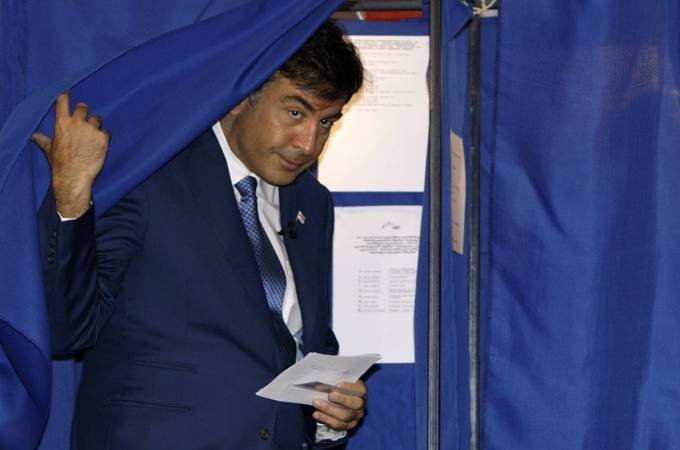
Georgian President Mikhail Saakashvili has
conceded defeat in parliamentary polls that
appear set to hand a shock victory to the
opposition Georgian Dream coalition.
"It is clear that the [opposition] Georgian
Dream has won a majority," Saakashvili said
in a televised speech on Tuesday.
Bidzina Ivanishvili's Georgian Dream
opposition coalition was leading
Saakashvili's ruling United National
Movement (UNM) by 53.19 per cent to 41.51
per cent after a quarter of electoral
precincts declared results on Tuesday in the
proportional ballot that will decide just
over half of parliamentary seats.
A complex electoral system means that the
ruling party could still take a large number
of seats, however.
First-past-the-post votes in 73
constituencies will make up the remainder of
the 150-seat parliament, and the opposition
was ahead in partial counts from seven out
of 10 such constituencies in its stronghold
Tbilisi.
'Solid' majority
The showdown between the opposition and the
Saakashvili's long-dominant party became
increasingly bitter after a prison torture
scandal prompted nationwide protests ahead
of the vote in the Western-backed ex-Soviet
state. The country has been ruled by the UNM
since the 2003 "Rose Revolution".
|
 |
|
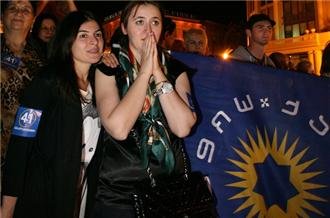
Supporters of opposition Georgian
Dream party celebrate their victory
in the parliamentary election [EPA] |
Ivanishvili declared victory immediately
after several exit polls suggested late on
Monday that his coalition was either ahead
or running neck-and-neck with the ruling
party in the proportional-vote section of
the contest.
"We have won! The Georgian people have won!"
he said in a televised speech. Ivanishvili's
supporters celebrated long into the night
after exit polls offered them hope of
victory with thousands of jubilant
supporters gathering late at night in
Tbilisi's central Freedom Square.
Cars full of more euphoric supporters raced
up and down the capital's main street,
sounding their horns, whistling and waving
flags.
Saakashvili said that while it appeared the
Georgian Dream coalition had won the
majority in the proportional vote, he
expected his party to do well in the
single-mandate constituencies.
The elections are crucial for Georgia's
future because its parliament and prime
minister will become stronger and the
presidency's powers will dwindle under
constitutional changes that come into force
after Saakashvili's two-term rule ends in
2013.
'Litmus test'
Before the torture scandal sparked by
revelations of the brutal beating and rape
of male prison inmates erupted last month,
most opinion polls gave the ruling party a
significant lead, but the outrage damaged
its campaign.
|
"The elections were held in an
unprecedentedly competitive
environment and the final result
will accurately reflect the people's
will"
- Zurab Kharatishvili,
Central Election Commission chief |
Turnout was 61 per cent, the Central
Election Commission said.
"The elections were held in an
unprecedentedly competitive environment and
the final result will accurately reflect the
people's will," the commission's chief Zurab
Kharatishvili said in a statement.
Ivanishvili, who made his fortune through
privatisation deals in Russia, had
threatened to call mass demonstrations
should Western observers fail to declare the
vote fair.
The polls were a "litmus test of the way
democracy works in Georgia," Anders Fogh
Rasmussen, the NATO secretary-general, said
on Monday.
Saakashvili's party controlled 119 of the
150 seats in the outgoing parliament and has
dominated Georgia since the charismatic
lawyer rose to power after the "Rose
Revolution" that toppled the country's
former leader, ex-Soviet foreign minister
Eduard Shevardnadze.
He was praised for modernising reforms that
brought Georgia back from the brink of
economic collapse and tackled widespread
corruption, but drew criticism for
crackdowns on protesters and the country's
disastrous defeat in a brief war with
arch-foe Russia in 2008.
Please visit the source, CNN for the article |